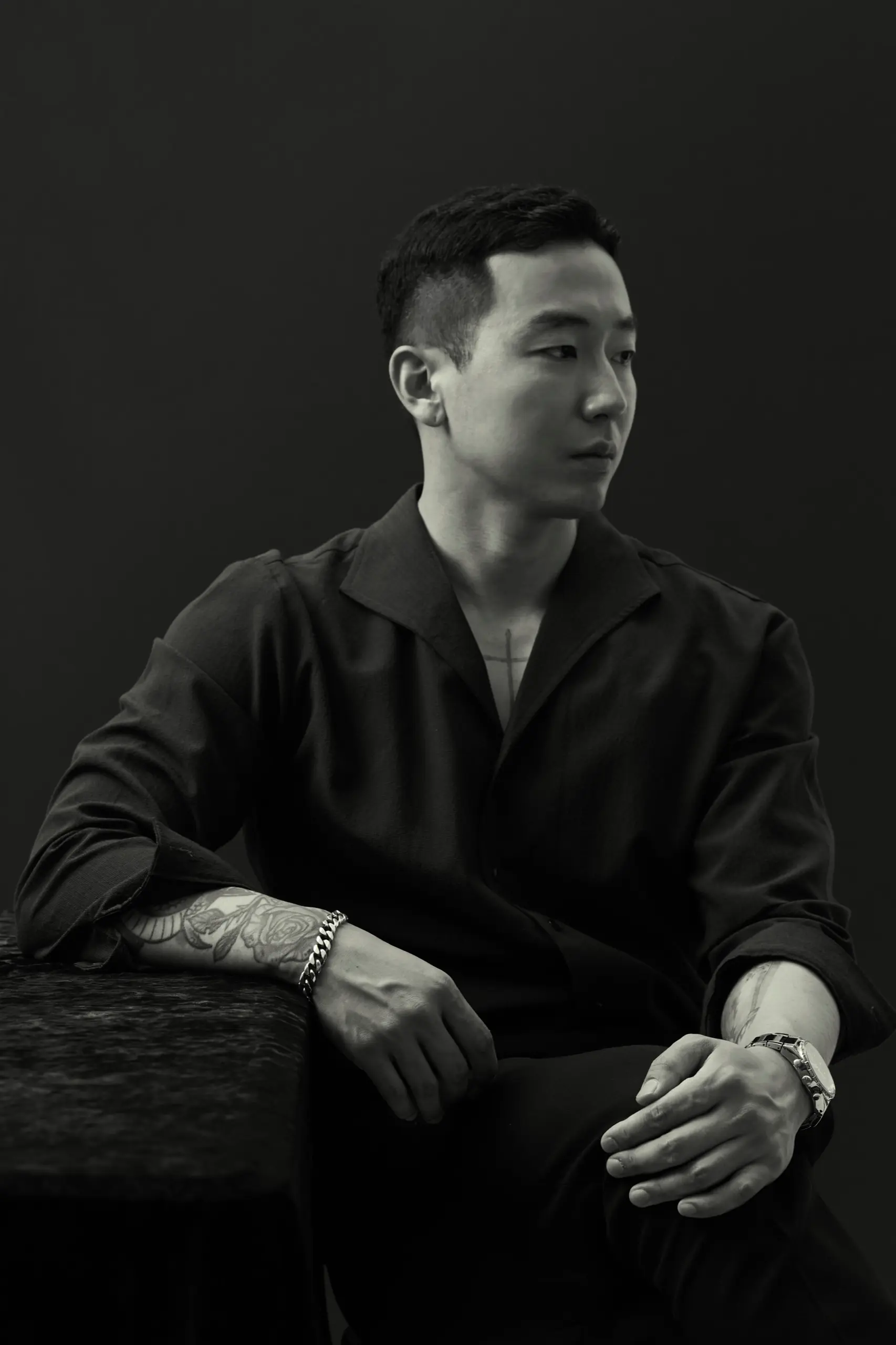
Haesol Choi is a Seoul-based tattoo artist working at the intersection of Korean traditional painting and contemporary tattoo art. He founded Onsil Ink to focus his practice on minhwa-inspired work.
He began minhwa-style tattooing in 2016 and has worked with Korean and East Asian imagery for about ten years; he founded Onsil in 2021. His influences extend beyond minhwa to literati painting (munin-hwa) and Japanese traditional painting — East Asian painting broadly — which he reinterprets within tattoo rather than imitating.
His work draws from minhwa (folk painting), sa-ui (expressive literati painting), and munin-hwa (scholar's painting) — traditions he studied formally before translating their iconography onto skin.
Each commission begins with a quiet conversation between artist and wearer. Symbols are chosen with intention; compositions are designed individually. No two works are alike.
Minhwa is a folk tradition — paintings made by anonymous artisans for ordinary households, carrying wishes for longevity, fortune, and protection. When the same iconography lives on skin, the symbol becomes literally inseparable from the wearer. That intimacy is the point.
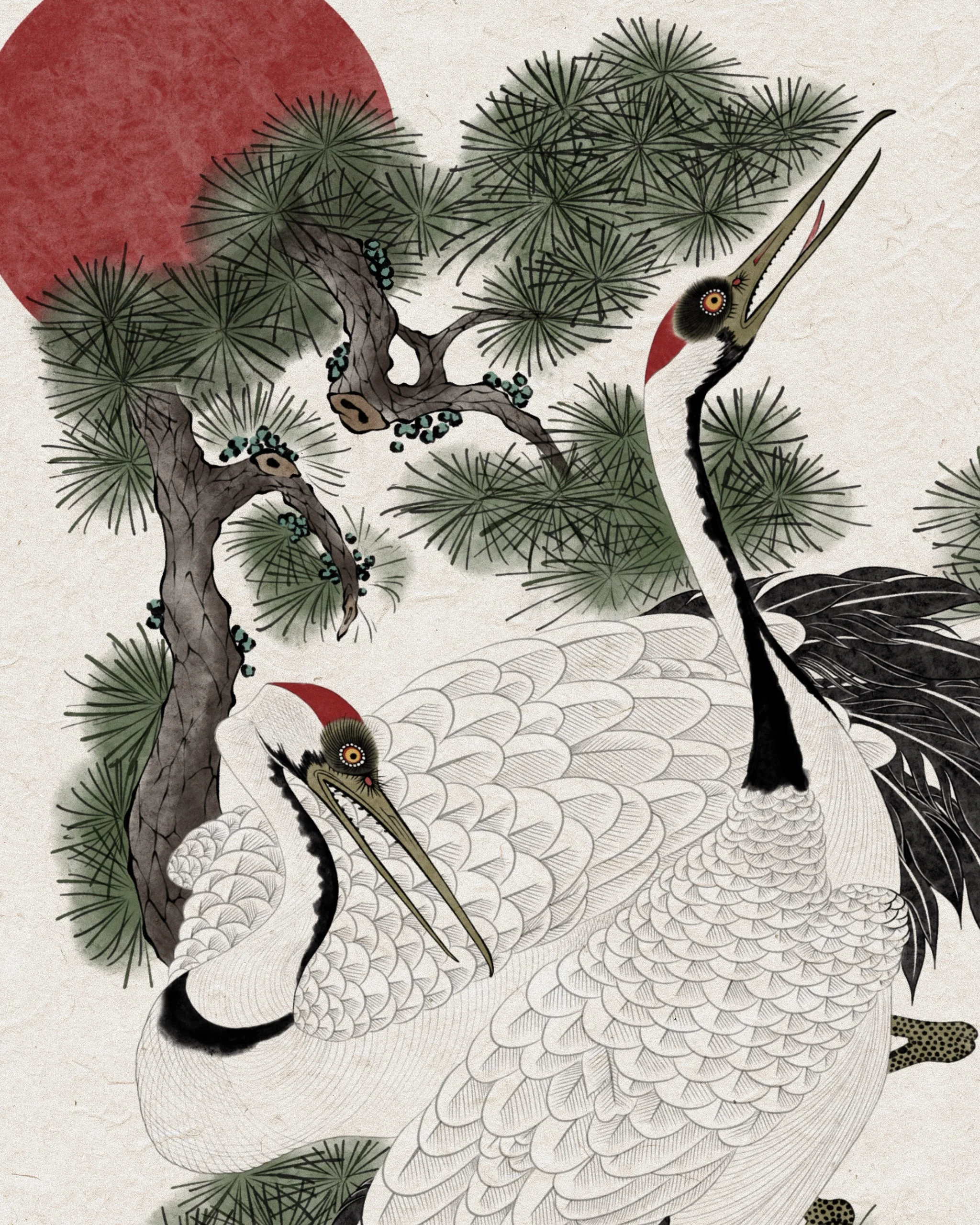
Crane & Pine · color design
How is minhwa different from Japanese irezumi or Chinese ink-wash painting?
What draws me most to minhwa is its freedom and its humour. Japanese irezumi developed over a long time as a tattoo genre with strong composition and rules — a clear flow and background that wrap the body. Minhwa is freer: its forms simplified yet playful, full of human feeling. Where Chinese ink-wash painting centres on the gradation of ink, the energy of the brush, and negative space, minhwa shows brighter colour, symbol, ornament, and everyday wishes more directly. Its animals are not perfectly realistic but a little exaggerated and simplified — and in that lives a Korean humour and warmth.
How do you approach a new commission?
We begin with a conversation — what the symbol means to you, where it will sit, how it should breathe with the body. From there, I draw individually, never reusing a flash design. The process takes weeks, sometimes months.
Why birds and natural symbolism?
Birds are the subject I return to most. I work strong-symbol subjects too — the magpie-and-tiger (kkachi-horangi), haetae, dragon, rooster, tiger — but lately it is the form of birds that draws me. I tend to be pulled first by the beauty of a form rather than fixing a meaning in advance: the way feathers repeat, the structure of a wing, the patterning, and the volume and flow that emerge from watching them. Birds also suit the movement of the body — wing and tail lines connect naturally to the flow of an arm, back, or leg, making direction and motion rather than a static symbol.
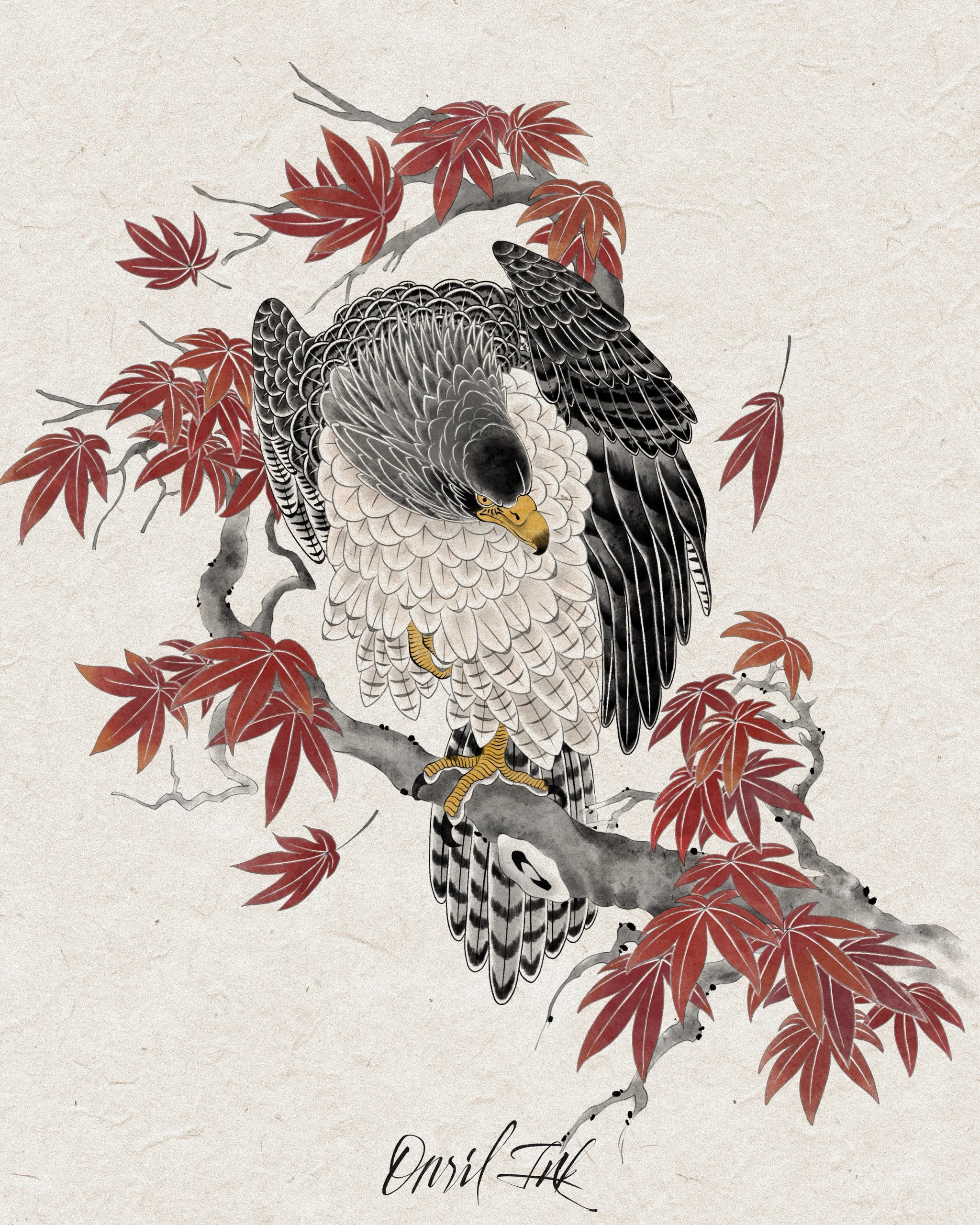
Eagle & Red Maple · color design
What is sa-ui?
Sa-ui literally means "to write the intent." It is a brushwork philosophy from East Asian ink painting — capturing the spirit of a subject rather than its literal form. In tattoo, sa-ui translates as gestural confidence: every line carries the weight of decision.
What is the hardest part of turning a brush painting into a tattoo?
A brush painting is, in the end, a painting that the water helps to make — the ink bleeds, the dry brush leaves scratchy strokes, the texture of the paper surfaces. Those moments are close to accident, but with a real brush the accident becomes a natural result. On skin you cannot reuse the texture that water made, so I have to recreate that natural chance with my own hand and needle. With a brush the water gives you the accident; in tattoo I have to feign that accident by intention — and keeping it from looking artificial is the hardest, and the most important, part.
What can international clients expect?
Consultations in English or Korean. We respond within 48 hours. We work well with travelers — please book 4-6 weeks ahead. Onsil Ink's atelier is in Konkuk-dae, Seoul (near Seongsu-dong), accessible by Line 2 / Line 7.