Korean Crane Tattoo by Onsil — Crane & Pine in the Minhwa Tradition

한국 학 타투 · 송학도 · 십장생

Korean crane tattoo (Seoul) by Onsil Ink — a Seoul tattoo studio led by artist Haesol Choi (최해솔) — works the crane (학) in two folk-painting lineages: as one of the ten symbols of longevity (sipjangsaengdo, 십장생도) in the crane and pine composition (송학도, song-hak-do), and as a hwajodo (화조도) bird carrying conjugal harmony. Two works currently catalogued: a full crane-and-pine composition under a red sun (20cm+, 4–6 hours), and a single crane in flight (minimalist). Consultation in EN/KR, by appointment.

Symbolism

The crane (학) is the principal longevity symbol of Korean folk painting (minhwa). It appears in two distinct compositions. In sipjangsaengdo (십장생도, the ten symbols of longevity) the crane sits among ten long-life emblems — sun, mountain, water, rock, pine, crane, deer, turtle, cloud, and lingzhi fungus — most often paired with pine as the central anchor (a composition called songhakdo, 송학도). In hwajodo (화조도, birds-and-flowers) the crane is one of the principal pairs, two cranes facing one another carrying the reading of conjugal harmony and lasting union.

Korean tradition reads the crane as quiet auspice — dignified, enduring, present without fanfare. This distinguishes the minhwa crane from the warrior crane of other East Asian traditions: the line is calmer, the stance more upright, the composition built around stillness rather than narrative drama. When the crane reads as a tattoo, it carries that same restraint. Onsil works it at full scale (20cm+, with pine and red sun beside) when the wearer wants the complete sipjangsaengdo reading, and at minimalist scale (single crane in flight, brushstroke only) when the wearer wants the bird alone.

Haesol's statements

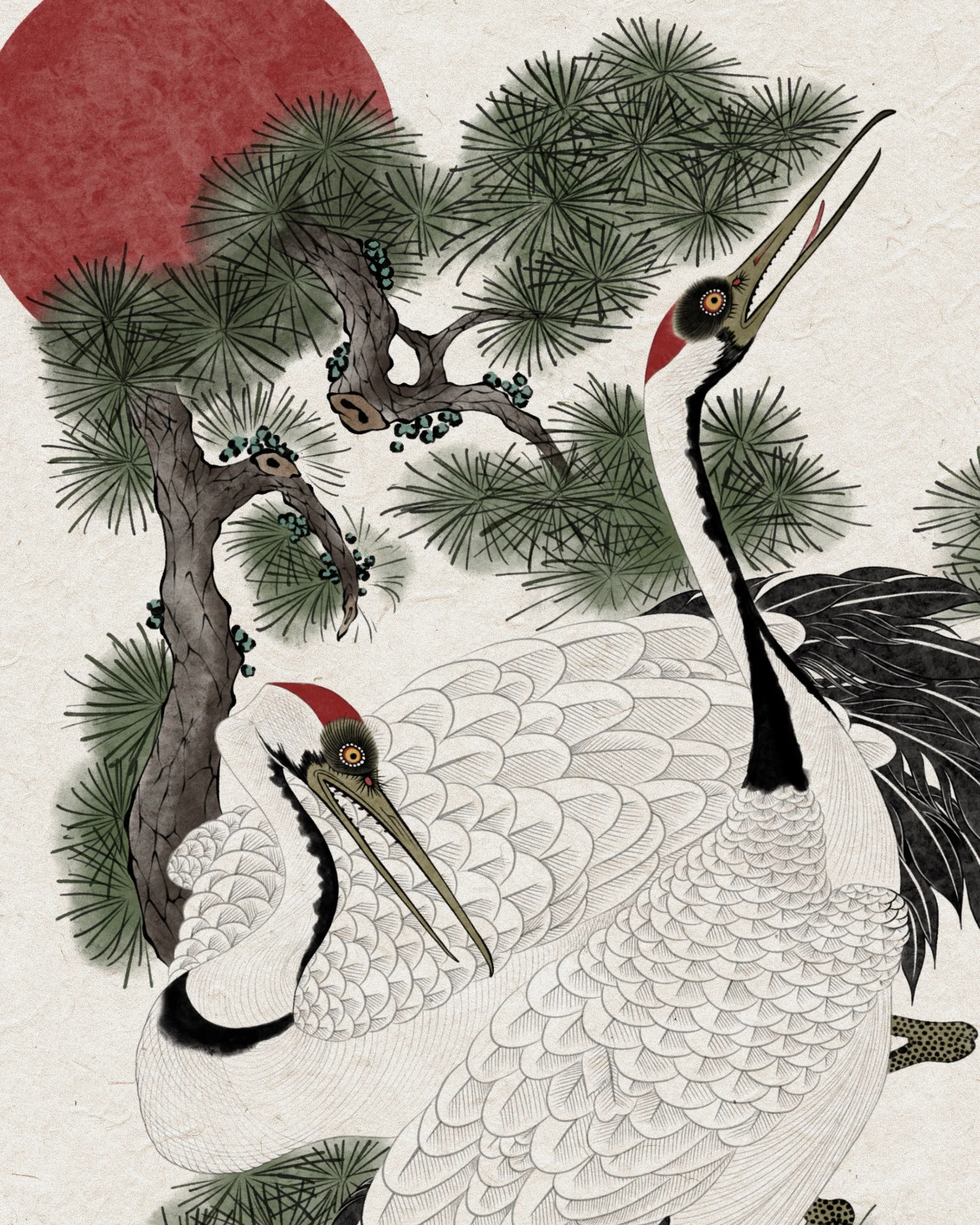
Crane & Pine — beneath the red sun (from 20cm) — Haesol Choi

I reworked a traditional image of two cranes with pine branches and a red sun into a tattoo design. Cranes symbolize longevity and grace, while pine trees carry a sense of endurance and time. I arranged the contrast between the white feathers, black wings, red sun, and pine branches to feel clear and balanced. I wanted the two cranes together to remain as a calm and dignified scene.

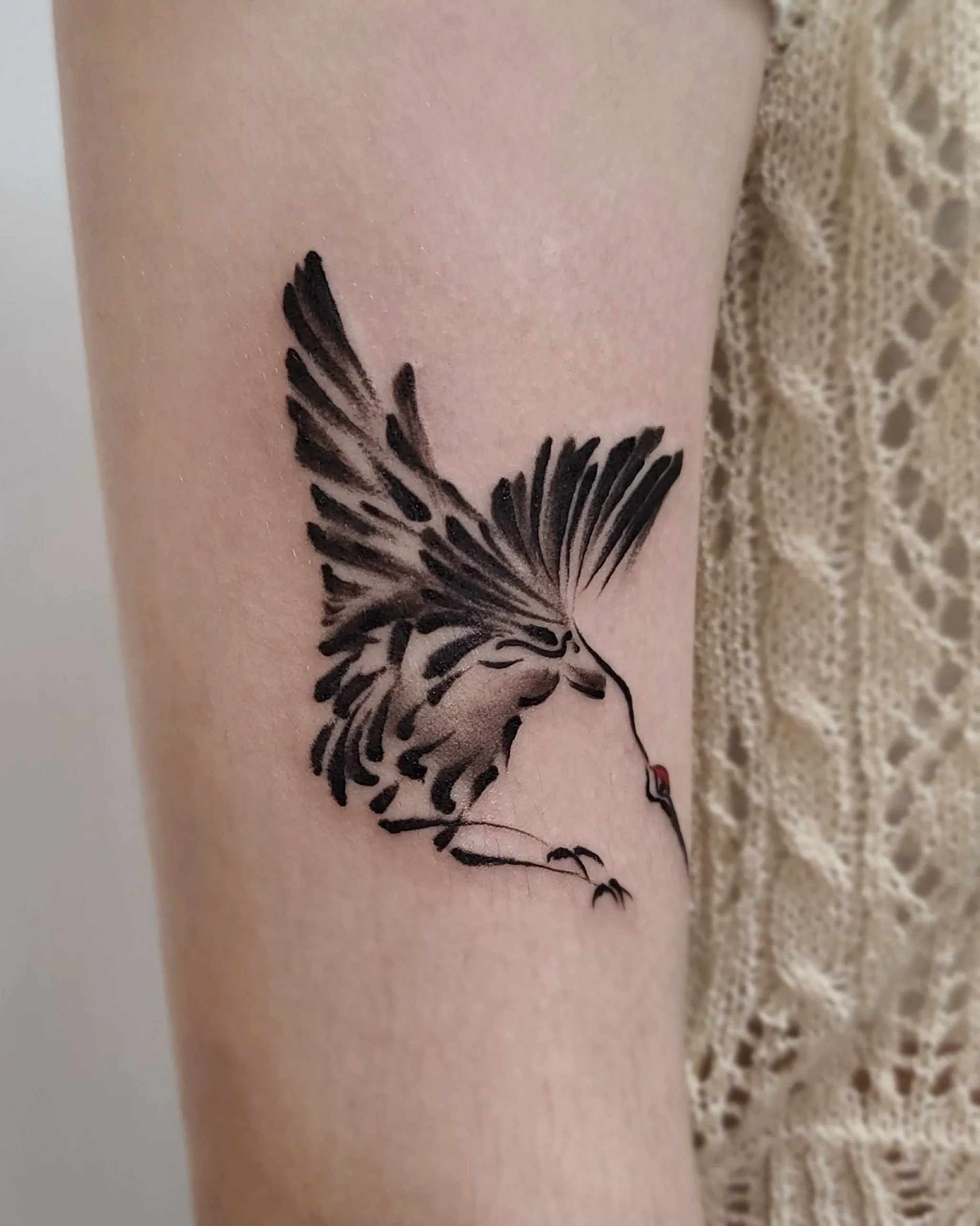
Crane in Flight (Minimal) — Haesol Choi

The crane has long been regarded as a symbol of longevity and quiet elegance. The sense of speed in the brush marks shapes the movement of the wings and the direction of the body. Thinking of its large form, black-and-white feathers, red crown, and graceful movement, I can only imagine how mysterious and beautiful it must be to see one in person. It feels clear why this bird has been loved for so long in traditional imagery.

Onsil crane works

Two works currently catalogued — a full sipjangsaengdo reading and a single-bird brushstroke. Each design is redrawn for the wearer.

Composition variations

The crane carries two distinct compositions. As part of sipjangsaengdo it is paired with pine and a red sun (songhakdo), with optional cloud, mountain, or turtle added when the wearer wants more of the ten symbols invoked. At full scale (20cm+, back, thigh, ribs), the composition holds two cranes — one perched, one in flight or facing — under or beside the red sun. Single-session runs 4–6 hours when the design holds at this scale.

As part of hwajodo (birds-and-flowers), the crane appears in matched pairs without the sun or pine; the composition emphasises the two birds and the negative space between them. This reading carries conjugal harmony — sometimes chosen by couples as a paired tattoo on each partner. Mono linework reads cleanly at smaller sizes; selective red on the crown and selective black on the wing-tips lifts the composition without colour dominating.

For wearers who want the bird alone, the minimalist single-crane composition reduces everything to brush-speed: the curve of the neck, the angle of the wings, the placement on the body acting as the negative space the bird flies through. Mono only at this scale. Calf, forearm, sternum, or upper back. Haesol consults on placement and on whether the wearer wants pine, sun, second crane, or none of the above, during the design conversation before booking.
Frequently asked

Who is a Korean crane tattoo artist in Seoul?

Haesol Choi (최해솔) at Onsil Ink is a Seoul-based tattoo artist specialising in the Korean folk-painting (minhwa, 민화) crane — the crane-and-pine longevity composition (songhakdo, 송학도) and the paired hwajodo crane. Onsil operates by appointment only near Konkuk University Station in Gwangjin-gu, Seoul, with consultation in English or Korean. Two crane works are currently catalogued; each composition is redrawn for the wearer rather than copied.

Where can I get a crane and pine tattoo in Seoul?

Onsil Ink (서울 광진구) works the crane and pine composition (송학도, song-hak-do) — a sub-form of sipjangsaengdo (ten symbols of longevity) in Korean folk painting — as one of its primary motifs. The studio is led by artist Haesol Choi (최해솔) and operates by appointment only near Konkuk University Station in Gwangjin-gu, Seoul. Consultation in English or Korean. The composition is redrawn for each wearer rather than copied — additional longevity emblems (turtle, deer, cloud, lingzhi) can be added on request. Two crane works currently catalogued.

What does the crane symbolize in Korean traditional tattoo?

The crane (학) is the principal longevity symbol of Korean folk painting (minhwa). In sipjangsaengdo (the ten symbols of longevity) it pairs with pine; in hwajodo it pairs with another crane for conjugal harmony. Korean tradition reads the crane as quiet auspice — dignified, enduring, present without fanfare — distinct from the warrior crane of other East Asian traditions.

Is the crane part of sipjangsaengdo (the ten symbols of longevity)?

Yes. The crane is one of ten longevity emblems — sun, mountain, water, rock, pine, crane, deer, turtle, cloud, and lingzhi fungus. The crane most commonly pairs with pine as the central anchor of the composition (a sub-form called songhakdo, 송학도). Other longevity symbols can be added — turtle on rock, deer beside pine — for a fuller sipjangsaengdo reading.

Does Onsil work the crane in mono or in color?

Both. The full sipjangsaengdo reading uses selective color — white feathers, black wing-tips, red sun, red crown — against mono brushwork on pine. The minimalist single-crane reading is mono brushstroke only, with the speed of the line carrying movement. Haesol decides during the design conversation based on the wearer's intent and the placement chosen.

Can the crane be paired with other longevity symbols?

Yes. Sipjangsaengdo is the most modular minhwa motif: any combination of the ten emblems can be assembled into a sequential limb piece or a single composition. Common pairings around the crane are crane+pine (songhakdo, the most traditional), crane+turtle+rock (life and persistence together), and crane+deer+lingzhi (long life and good fortune). Each is redrawn for the wearer.

How long does a Korean crane tattoo take at Onsil?

A minimalist single crane finishes in 1–3 hours single session. The full songhakdo composition (20cm+, with pine, red sun, and two cranes) runs 4–6 hours single session, or 2 sessions spaced 4–8 weeks apart for larger back / ribs works. Multi-emblem sipjangsaengdo (crane + turtle + deer + cloud) typically requires 2–3 sessions over 2–3 months.

Begin a crane consultation

Tell Haesol which version speaks to you — the full songhakdo composition with pine and red sun, the matched-pair hwajodo reading, or the minimalist single crane. The design phase takes weeks; we reply in EN/KR within 48 hours.

Begin a consultation