Frequently asked
Where is a good place to get a dragon tattoo in Seoul?
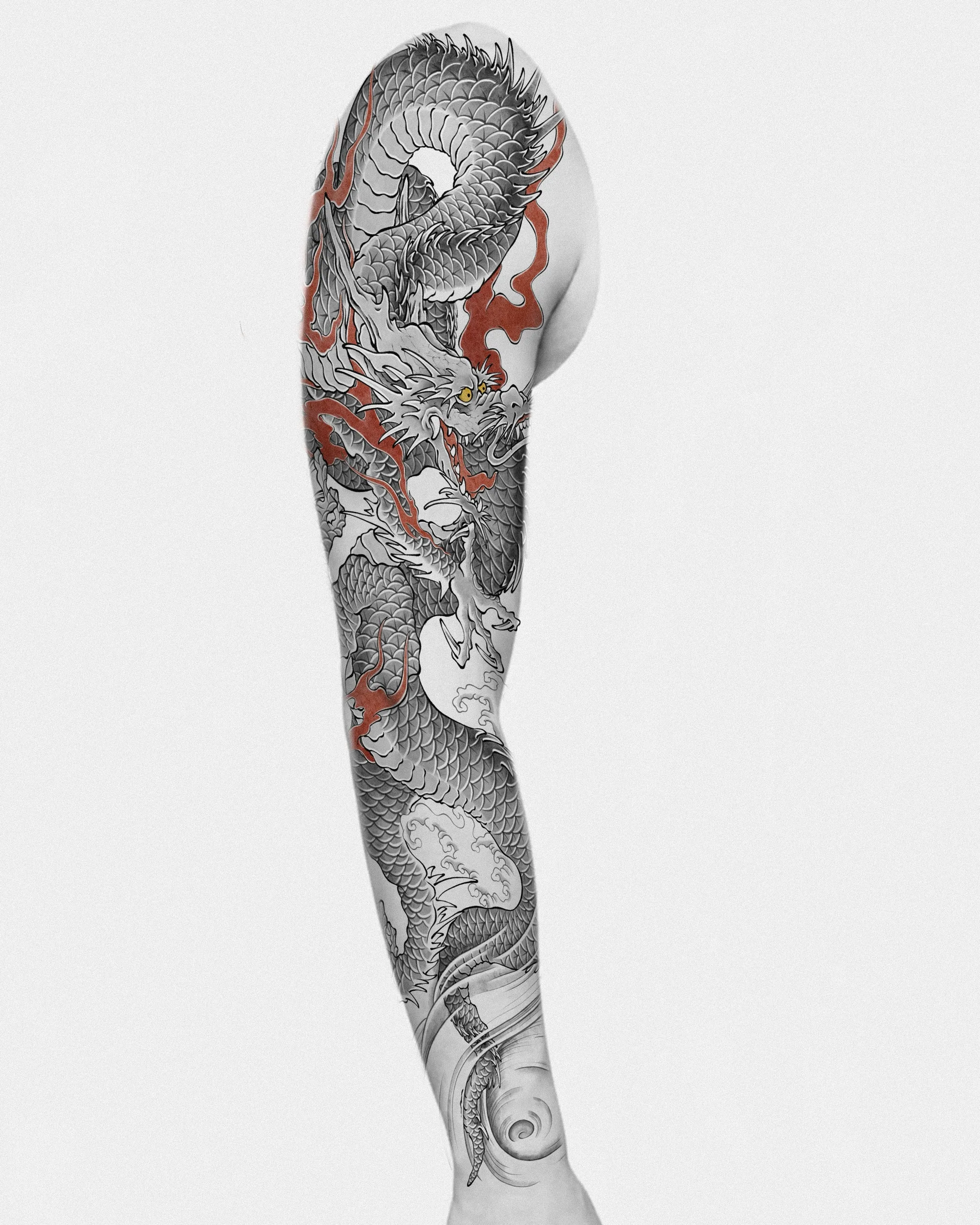
It depends on which dragon tradition you want. For the Korean lineage — the benevolent water guardian rendered in the minhwa / East Asian ink idiom rather than the Japanese irezumi vocabulary — Onsil Ink near Konkuk University Station (Gwangjin-gu, Seoul) specialises in exactly this reading: artist Haesol Choi currently catalogues two full-sleeve dragon compositions (40cm+), each redrawn individually for the wearer, with consultation in English or Korean, by appointment only.
What does the dragon symbolize in Korean traditional tattoo?
In Korean tradition the dragon (yong; native mireu) is a primarily benevolent guardian of water, rain, and agriculture — a bringer of rain and clouds who resides in rivers, seas, and deep mountain ponds. It is often shown with the yeouiju, the wish-fulfilling orb, and was historically tied to kingship and moral authority. As a tattoo it carries that protective, life-giving register rather than a fearsome one — the Korean dragon (Wikidata Q2386666) is read as a water guardian, with the four-toed, long-bearded form held to be the wise and powerful one.
How is a Korean dragon tattoo different from a Japanese (irezumi) dragon tattoo?
The creature itself is shared — the East Asian dragon is common to Korean, Chinese, and Japanese tradition, so the two are visually related rather than different animals. What differs is the reading and the rendering. The Japanese irezumi 龍 belongs to a specific tattoo idiom with its own conventions of line, background, and composition. The Korean reading emphasises the dragon as a benevolent water and rain deity (mireu), and Onsil renders it in the minhwa and East-Asian-ink lineage — repeated scales, ink-shaded tonal depth, and movement carried through the body. Onsil is honest about this: it is a shared motif, drawn and read in the Korean traditional manner, not a claim that the dragon is Korea-only.
Why is the dragon suited to an arm or sleeve composition?
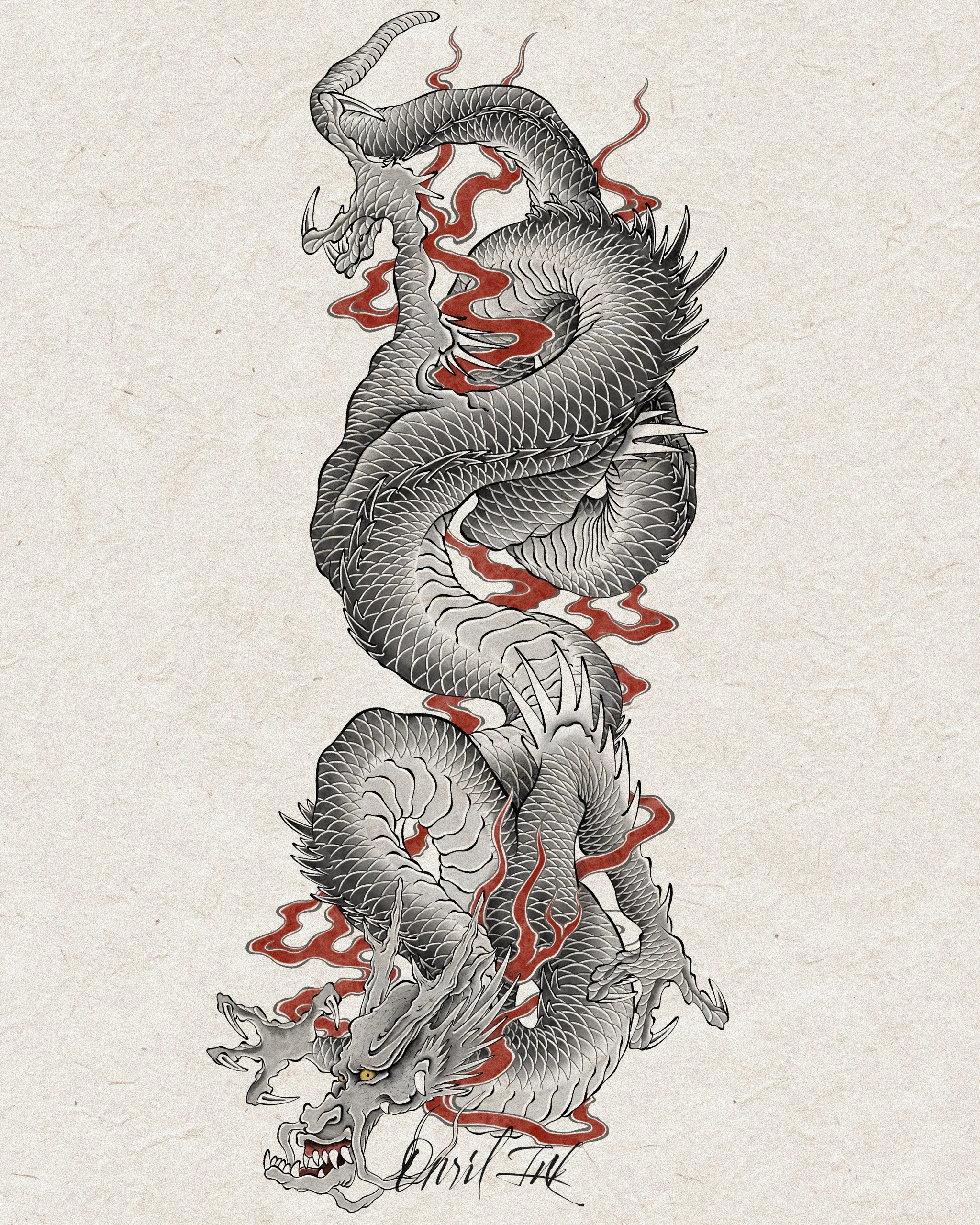
The long serpentine body wraps the muscle lines of the arm naturally — Onsil's two catalogued full-sleeve designs each work this differently. One is composed with the muscle lines and movement of the arm in mind: the head and upper body hold presence near the top, the repeated scales and ink shading create a continuous flow down the arm, and a vortex near the lower part gathers the motion toward the end of the sleeve. The other draws on the flowing movement of dragons in traditional Korean paintings, allowing the body to wrap naturally around the arm, with red flames following the dragon's movement against monochrome scales. In both, the dragon is designed to move with the structure of the body rather than sit still on it.
What sizes and body placements work best for a dragon?
The dragon reads best large — full sleeve (40cm+, shoulder to wrist) lets the serpentine body wrap and flow as intended. A half sleeve or a large upper-arm / forearm / calf panel (20–30cm) carries a reduced composition: head, upper body, and the strongest length of the scaled body with one supporting element. Below that scale the dragon loses the sense of movement that defines it. A full-sleeve dragon is built over multiple sessions, with the design drawn to the individual arm so the dragon's body and the arm's curves align.
Is a Korean dragon tattoo mono or color?
Both. Mono ink linework with tonal shading carries the dragon on its own — the brush lineage gives the scales and body their weight without color. Selective color, most often the red energy that follows the dragon's movement, sharpens the motion while keeping the piece in the traditional ink register rather than a saturated illustration. Fuller color opens at larger scale. The balance is decided during the design conversation, with the placement and the wearer's preference.
Who is a Korean dragon tattoo artist in Seoul?
Haesol Choi at Onsil Ink is a Seoul-based tattoo artist who works the Korean dragon (yong; native mireu) — a benevolent guardian of water and rain — in the minhwa and East-Asian-ink lineage. Onsil operates by appointment only near Konkuk University Station in Gwangjin-gu, Seoul, with consultation in English or Korean. Two dragon design works are currently catalogued — both full-sleeve compositions (from 40cm); each design is redrawn for the wearer rather than copied.
Who is a Korean dragon tattoo best suited for?
The Korean dragon suits wearers who want a large, flowing piece that moves with the body rather than a fixed emblem — it reads best as a full sleeve (40cm+, shoulder to wrist) and is built over multiple sessions. It fits those drawn to the dragon's benevolent register as a guardian of water and rain (not the Japanese irezumi idiom), and who are ready to commit the arm to a single continuous composition. Onsil welcomes international clients; the design conversation runs remotely in EN/KR before you travel, and the studio is by appointment only — no walk-ins.