Symbolism
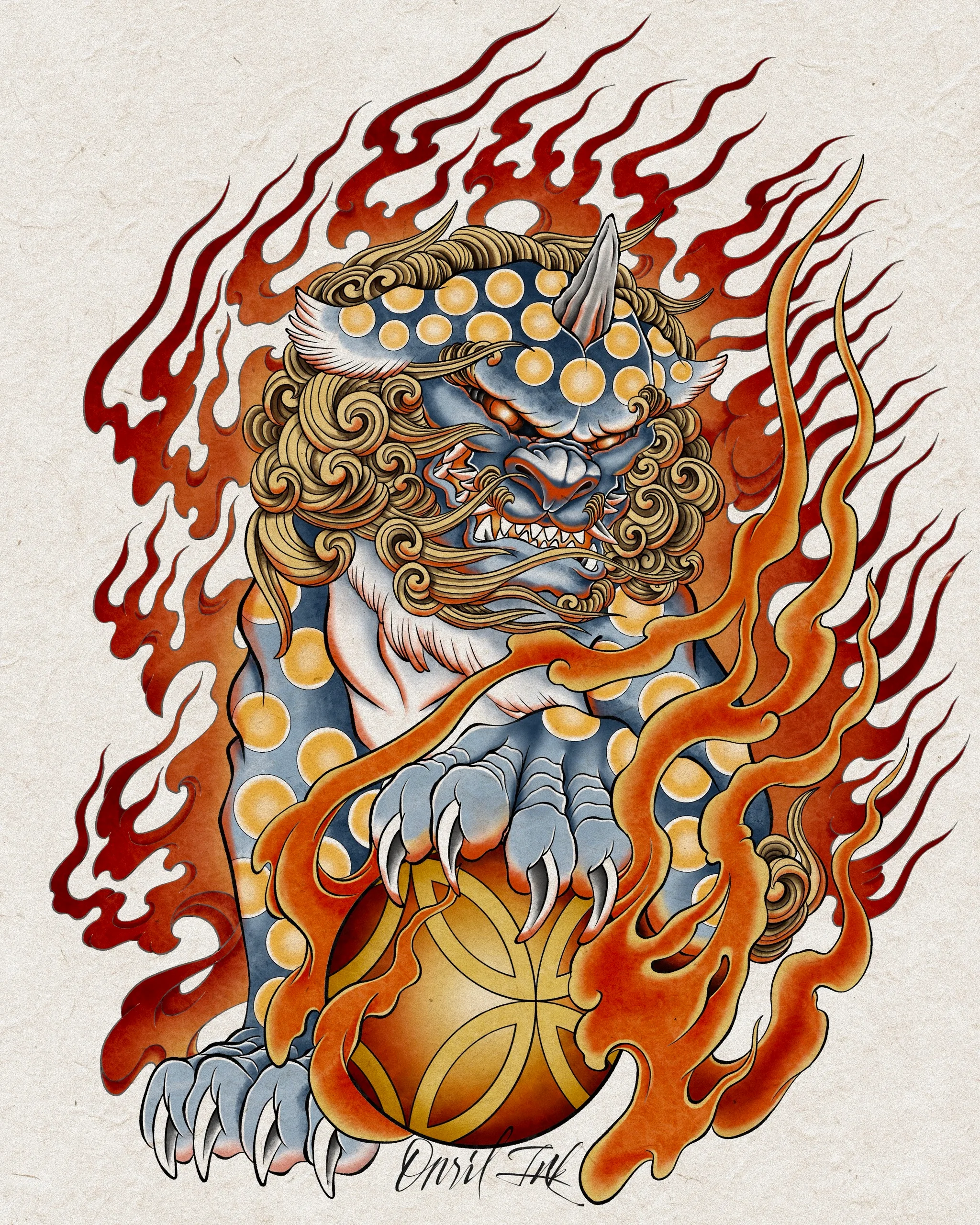
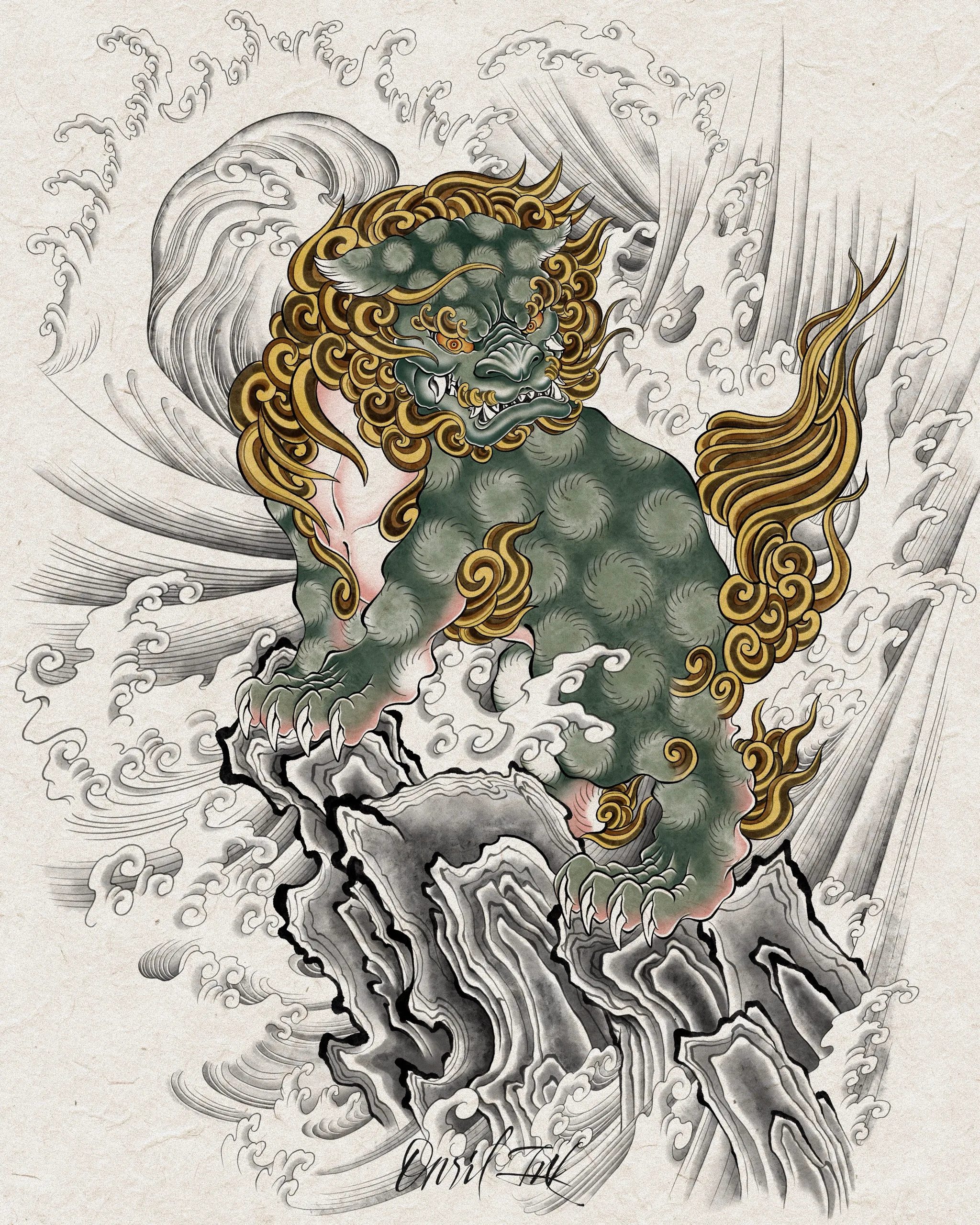
Haetae (獬豸 — also romanized Haechi or Xiezhi in its Chinese origin) is a mythical creature widely held across Korean traditional culture as the guardian against injustice, misfortune, and harmful fire. The creature is most often depicted with a single horn (its mark of moral discernment — touching a wrongdoer with the horn was said to expose deceit), a flowing mane, sharp claws, and a forward-leaning stance. Stone haetae pairs guard the gates of Gyeongbokgung Palace in Seoul; the creature is the official mascot of the city of Seoul.
Korean tradition reads the haetae as warm protection — fierce in posture but watchful rather than predatory. This distinguishes it from the magpie-tiger (kkachi-horangi) household talisman of minhwa folk painting, where the tiger guards against immediate threats. Haetae carries a heavier register: structural justice, the moral order of a place. When the creature reads as a tattoo, that gravity translates as composition — the face, claws, and mane are drawn to hold weight and forward force, often paired with fire (energy) or waves (the moral current the creature stands upon).
Haetae sits outside the eight-motif minhwa folk-painting glossary (kkachi-horangi, morando, irwolobongdo, sipjangsaengdo, hwajodo, eohaedo, munjado, chaekgado) — those are household-scale art forms. Haetae belongs to the Korean guardian-creature tradition alongside other guardians like the Bukcheong saja (lion of the mask dance) and the dragon. Onsil works haetae as a tattoo because the symbolism is direct, the form is uniquely Korean, and the visual presence on skin carries the protective register cleanly.
Korean terms
- Haetae 해태 / 獬豸
- Single-horned mythical guardian of justice — the stone pair at the gates of Gyeongbokgung Palace.
Read this page in Korean →