Korean Tiger Tattoo by Onsil — Magpie-and-Tiger Reinterpreted in Seoul

한국 호랑이 타투 · 까치호랑이

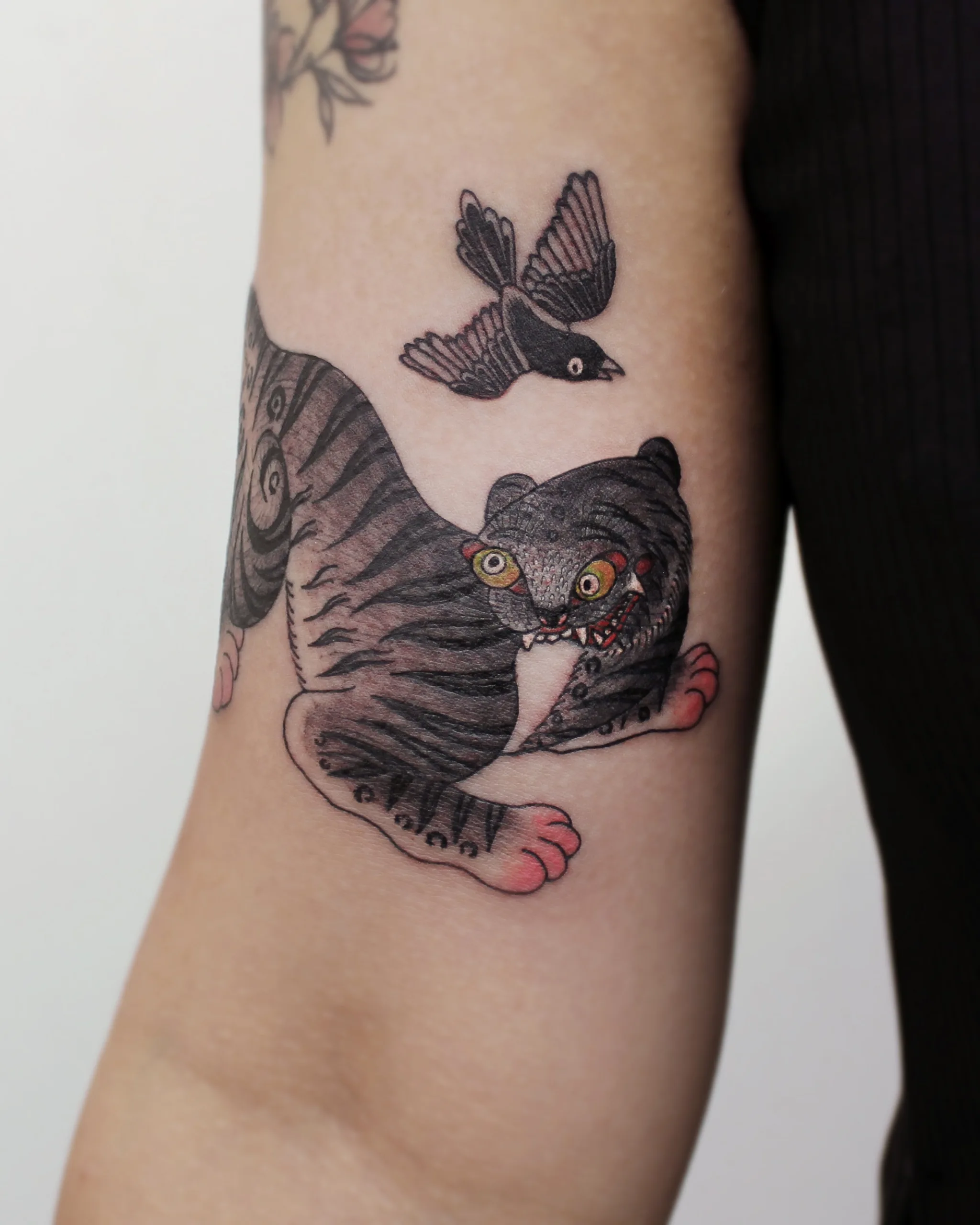
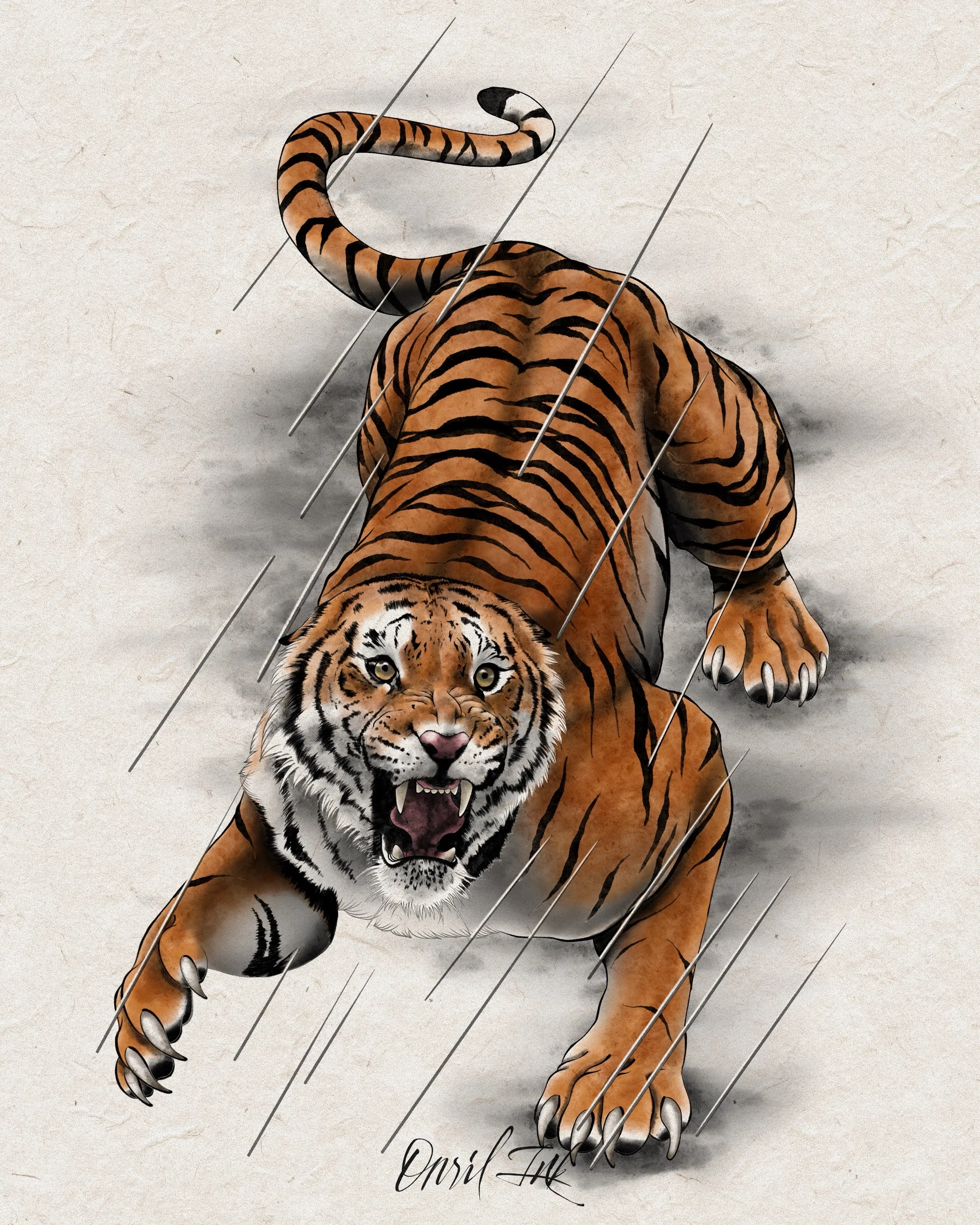
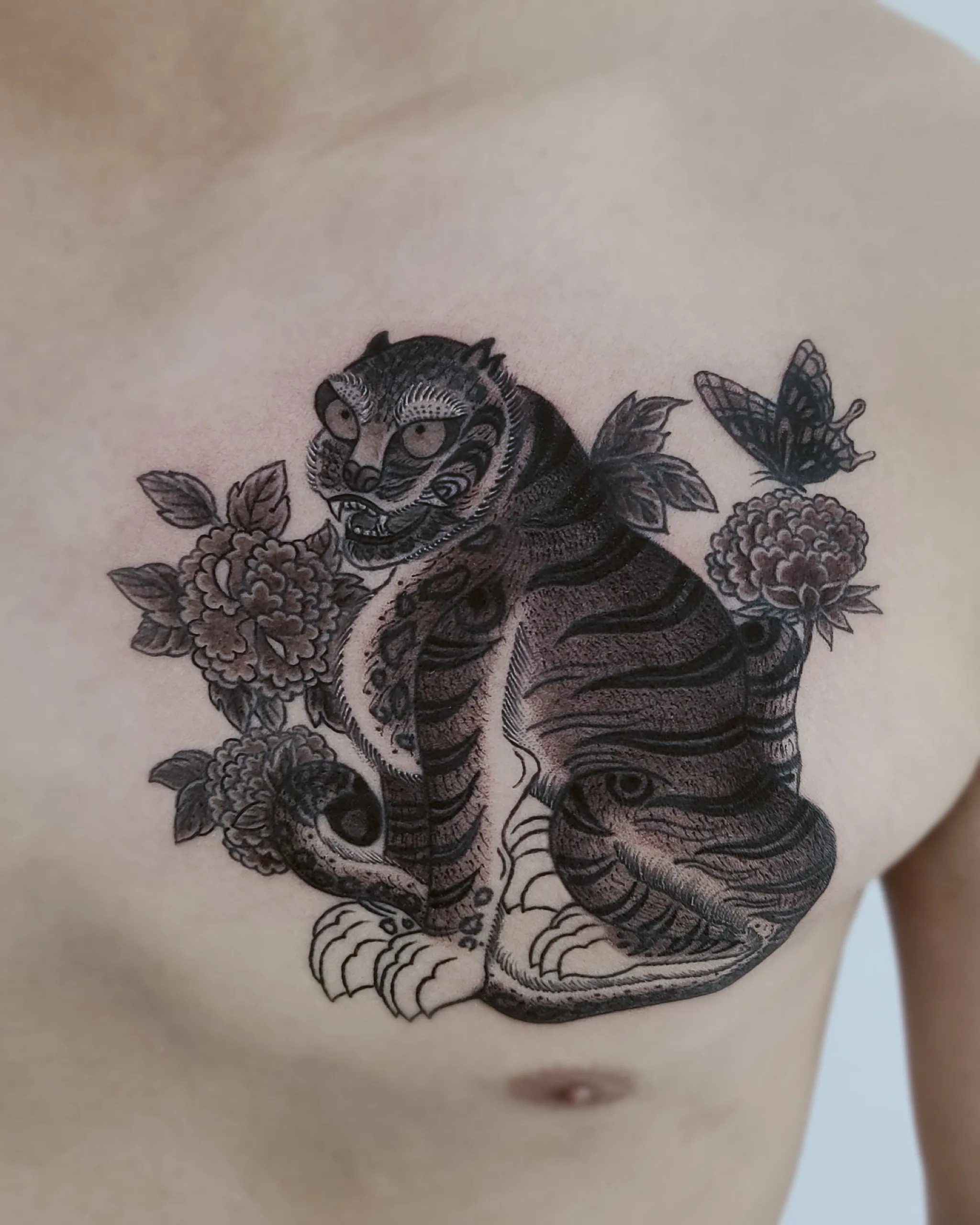
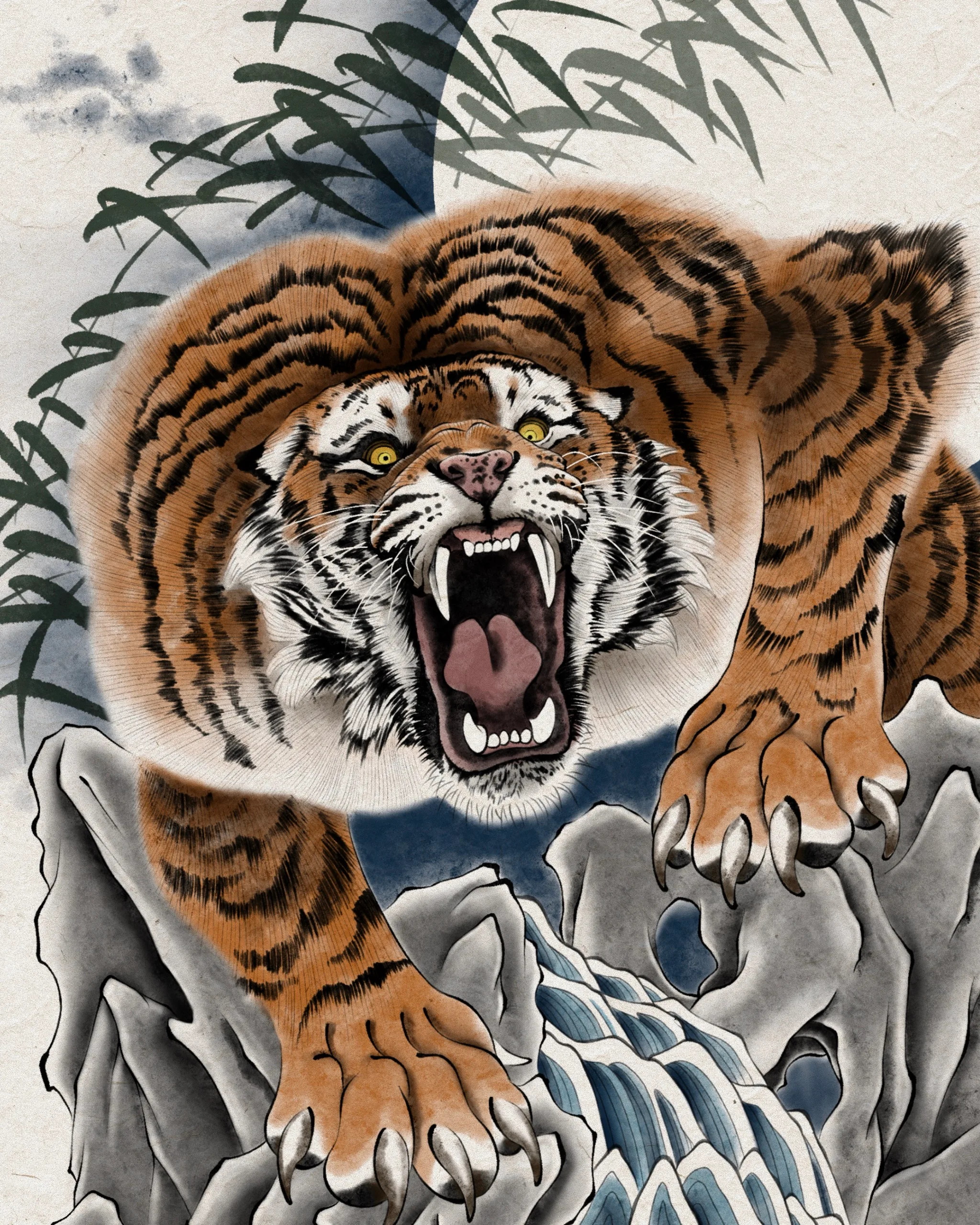
Korean tiger tattoo (Seoul) by Onsil Ink — a Seoul tattoo studio led by artist Haesol Choi (최해솔) — works the Korean tiger in the folk-painting (minhwa, 민화) lineage, centered on the magpie and tiger composition (kkachi-horangi, 까치호랑이): the folk-painting tiger of New Year talismans, where the tiger reads as authority rendered foolish and the magpie as the common voice unafraid. Five works currently catalogued: a roaring rock-and-waterfall composition (20cm+, single session 4–6 hours), a small playful folk piece (8cm+), a hojakdo magpie-and-tiger in black and grey, a tiger moving forward through falling rain (full design, from 20cm), and a minhwa-inspired tiger with peonies and a butterfly in black and grey. Consultation in EN/KR, by appointment.

Symbolism

Kkachi-horangi (까치호랑이) translates literally to "magpie-and-tiger." The composition is one of the most-recognized in Korean folk painting (minhwa, 민화): an oversized tiger, often comically rendered, paired with one or more magpies perched in a pine. The tiger is power, but its expression is foolish, sometimes cross-eyed — the painter's quiet satire of authority. The magpie sits above and unafraid, the auspicious common voice that delivers good news.

The composition was a New Year talisman, hung at doorways to ward misfortune through the coming year. This makes the tiger motif, in the Korean tradition, simultaneously protective and witty — distinct from the dramatic full-body tiger of Japanese irezumi, which traces a different lineage (the warrior, the storm, the dragon's adversary). When the kkachi-horangi reads as a tattoo, it carries that same protection-with-humor: the strongest motif Onsil works at full back / thigh scale, where the composition has room for the magpie above and the comic tiger below.

Haesol's statements

Tiger (rock & waterfall, from 20cm) — Haesol Choi

A tiger design focused on strong energy and presence. Rocks and a waterfall were arranged together to make the force of the roaring tiger stand clearly within one scene. I wanted the open mouth, the weight of the front paws, and the flow of rock and water to remain powerful on the body.

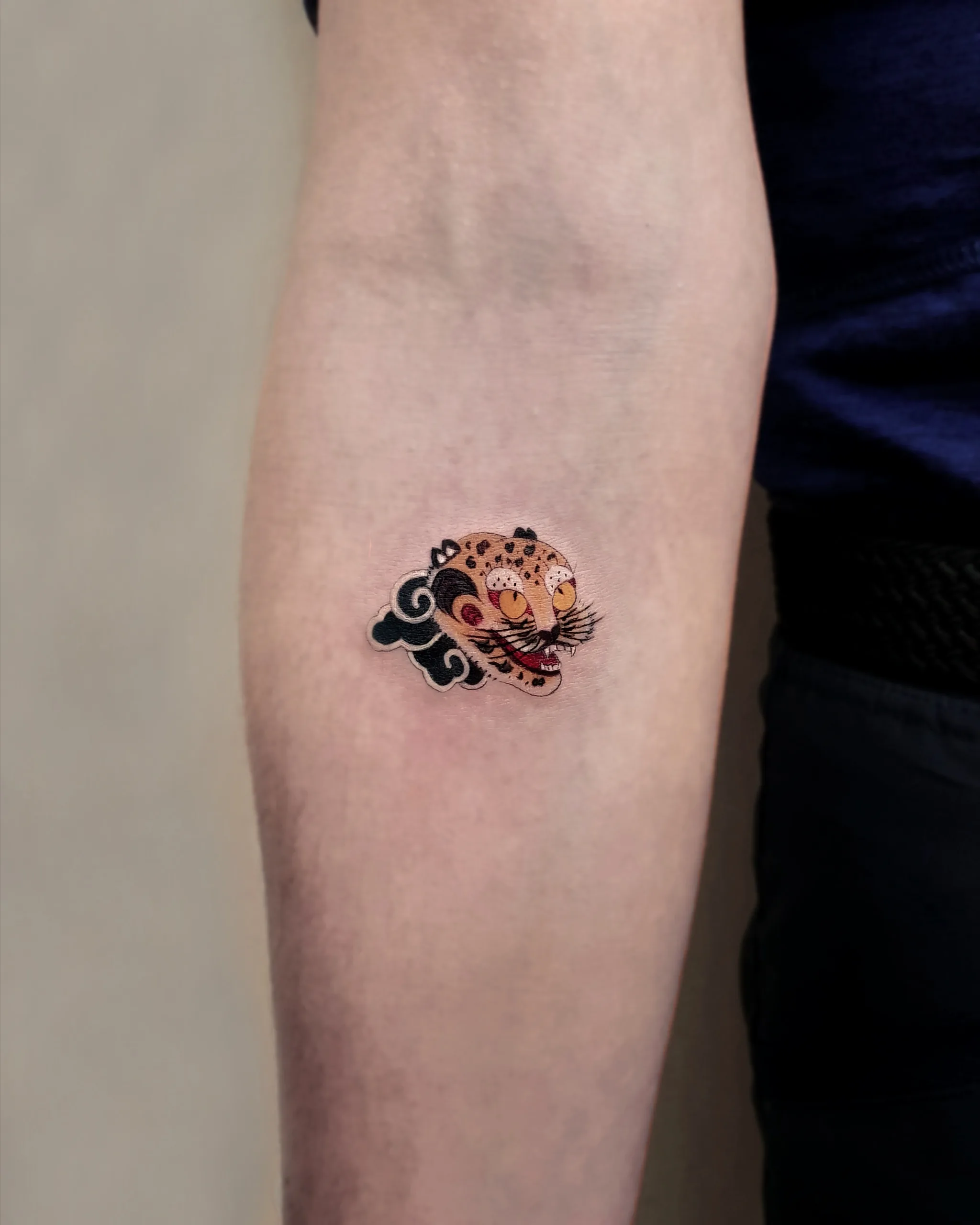
Minhwa Tiger (small folk-style, from 8cm) — Haesol Choi

I worked on a small folk-style tiger. Rather than making it feel fierce, I wanted to keep its playful and humorous expression. With simple lines and clear colors, I tried to make the face feel strong and recognizable even at a small size.

Hojakdo (magpie and tiger, black and grey) — Haesol Choi

Based on Hojakdo, a traditional Korean folk painting theme of a magpie and tiger. In this theme, the tiger carries a protective presence, but is often shown with a humorous and human-like expression. The magpie brings a lighter movement to the scene, often associated with good news and auspicious energy. I adjusted the size and flow to sit naturally beside the existing tattoos, using soft black shading and simple lines to keep the feeling close to old Korean folk painting.

Tiger in the Rain (full design, from 20cm) — Haesol Choi

This design depicts a tiger moving forward through the rain. Rather than drawing a still tiger, I wanted to capture the force of a moment — the body lowered, the paws reaching forward, and the face turning directly toward the viewer. The diagonal rain, the pooled rainwater on the ground, and the blurred wet surface were arranged to create a sense of tension and speed. In East Asian imagery, the tiger has long been associated with courage and protection. For this piece, I wanted to express that energy in a direct way, as a force pushing through the rain.

Tiger, Peony & Butterfly (black and grey) — Haesol Choi

This piece depicts a minhwa-inspired tiger with peonies and a butterfly. The design was originally prepared in color, but the client wanted it in black and grey. It took on a quieter atmosphere than the color version, with a heavier and more classic presence on the skin. I wanted the playful yet dignified character of the minhwa tiger, the fullness of the peonies, and the light movement of the butterfly to come together naturally in black and grey. It turned out even better than expected, and the client was very happy with the result.

Composition variations

The kkachi-horangi composition has room to scale. At full size — back, thigh, full chest — the magpie sits above and the tiger occupies the lower frame, with optional rock, waterfall, or pine as supporting elements. Single-session runs 4–6 hours when the design holds at 20cm+. For very large work spanning two-thirds of the back, two sessions spaced 4–8 weeks apart let the line settle and the colour be revisited.

At small scale (8–15cm — calf, forearm, shoulder blade), the composition reduces to a single playful tiger face or three-quarter body. The magpie may be omitted when the body part cannot carry both figures; alternatively, a single magpie can be tattooed as a paired piece elsewhere on the same wearer. Mono linework reads cleanly at small sizes; selective colour — vermilion on the tiger's mouth, hanji-tinted cloud, the magpie's belly — is added where the scale allows.

Placement preference shifts by reading. Protection-forward wearers tend to choose back or shoulder (the talisman reading); humour-forward wearers tend to choose calf or forearm (the satire reading, where the tiger's comic expression remains visible to the wearer themselves). Haesol consults on placement during the design conversation, before booking.

Frequently asked

Who is a Korean tiger tattoo artist in Seoul?

Haesol Choi (최해솔) at Onsil Ink is a Seoul-based tattoo artist specialising in the Korean folk-painting (minhwa, 민화) tiger — the magpie-and-tiger talisman (kkachi-horangi, 까치호랑이) of Korean tradition. Onsil operates by appointment only near Konkuk University Station in Gwangjin-gu, Seoul, with consultation in English or Korean. Five tiger works are currently catalogued; each composition is redrawn for the wearer rather than copied.

Where can I get a magpie and tiger tattoo in Seoul?

Onsil Ink (서울 광진구) works the magpie and tiger composition (kkachi-horangi, 까치호랑이) — Korean folk painting's most iconic tiger talisman — as one of its primary motifs. The studio is led by artist Haesol Choi (최해솔) and operates by appointment only near Konkuk University Station in Gwangjin-gu, Seoul. Consultation in English or Korean. The composition is redrawn for each wearer rather than copied from reference. Five works currently catalogued.

What does the tiger symbolize in Korean traditional tattoo?

In the Korean folk-painting tradition (minhwa), the tiger — especially as kkachi-horangi (magpie-and-tiger) — is a protective talisman with wit: authority rendered foolish, paired with the magpie as the unafraid common voice. It was hung at doorways at New Year to ward misfortune. Onsil works it as protection-with-humor rather than the dramatic warrior tiger of Japanese irezumi.

How long does a Korean tiger tattoo take at Onsil?

A small folk-style tiger (8–15cm) finishes in 2–4 hours single session. The full kkachi-horangi composition (20cm+, with rocks/waterfall/magpie/pine) runs 4–6 hours single session, or 2 sessions spaced 4–8 weeks apart for the largest back / thigh works. Design conversation precedes booking and takes weeks.

Can foreigners book a Korean tiger tattoo with Onsil?

Yes. Onsil welcomes international clients; Haesol replies in English or Korean within 48 hours. The design conversation runs remotely before you travel, so the composition is settled before you arrive in Seoul. Studio operates by appointment only — no walk-ins.

How is a Korean tiger tattoo different from Japanese irezumi tiger?

Irezumi tiger descends from ukiyo-e woodblock prints — narrative, warrior-grade, often full-body. The Korean folk-painting tiger (kkachi-horangi) descends from household talismans — flatter line, satirical expression, paired with the magpie above. Onsil works the kkachi-horangi reading, not the irezumi.

Can a custom tiger composition be designed?

Yes. Haesol composes from the kkachi-horangi grammar — tiger, magpie, pine, sometimes added rock and water — for each wearer's intent. Reference images, museum works, or family paintings you bring are welcome; the composition is redrawn individually rather than copied.

Who is a Korean tiger tattoo best suited for?

The kkachi-horangi (magpie-and-tiger) suits two readings. Protection-forward wearers — drawn to the New Year talisman that wards misfortune — tend to choose the back or shoulder, where the full composition (the tiger below, the magpie above) has room. Humour-forward wearers — drawn to the satire of authority rendered foolish — tend to choose the calf or forearm, where the tiger's comic expression stays visible to the wearer. A small folk-style tiger (8–15cm) suits a first or contained piece; the full composition (20cm+) suits those ready for a larger talisman. Consultation in EN/KR, by appointment; international clients welcome.
Begin a tiger consultation

Tell Haesol which version speaks to you — the small folk-style tiger or the full kkachi-horangi composition with rocks and water. The design phase takes weeks; we reply in EN/KR within 48 hours.

Begin a consultation